
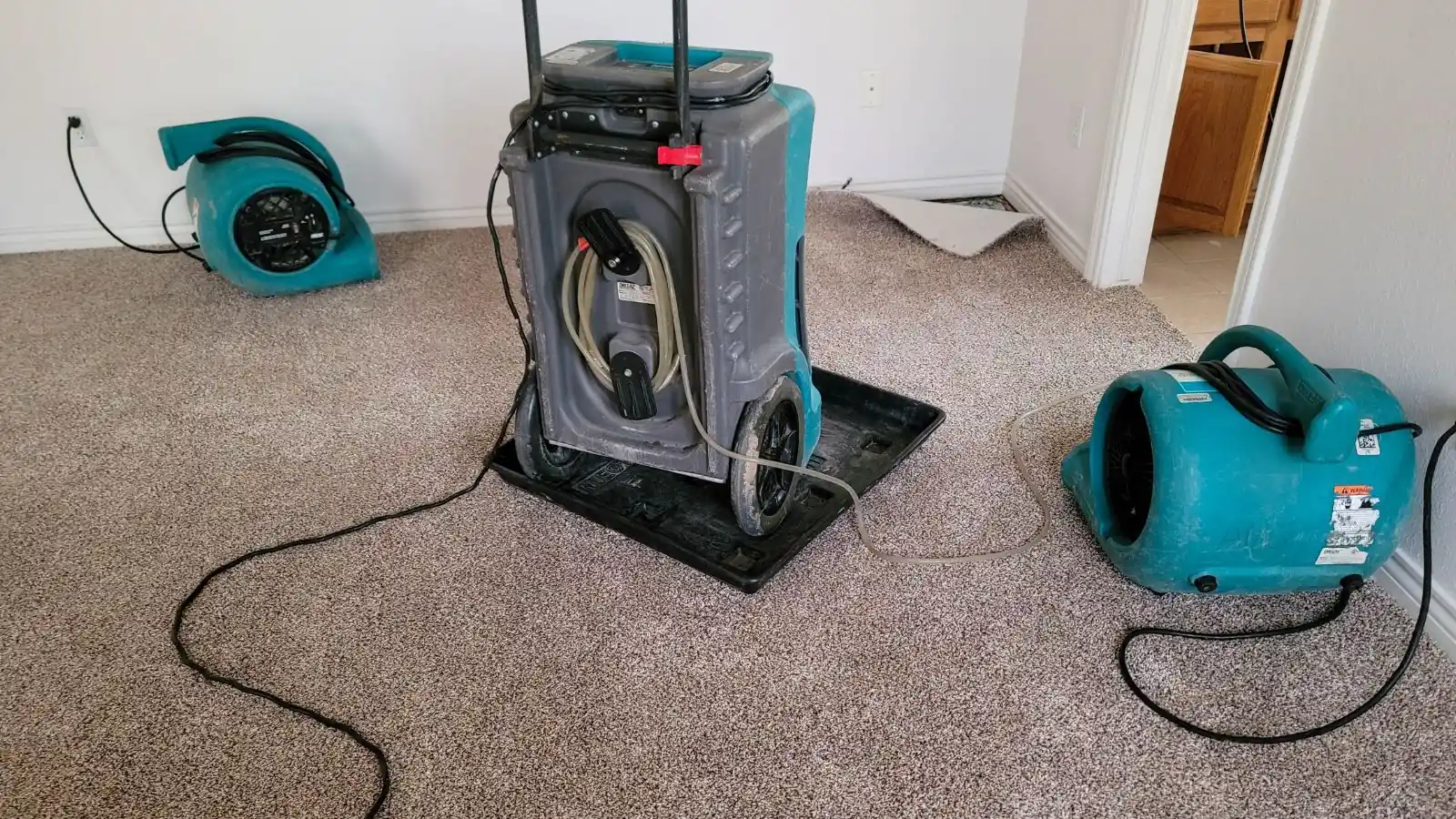
In the water damage trade, mitigation and remediation usually refer to the early work of stopping damage and removing water, while restoration often refers to rebuilding. Remediation also has a specific meaning with mold, where New York regulates it.
Companies mix these words, so ask what a bid includes. This guide sets out the stages and the questions that sort them.
The stages in order
| Stage | What happens |
|---|---|
| Mitigation | Stop the source, extract water, protect belongings, start drying. |
| Drying | Use air movers and dehumidifiers until moisture readings are normal. |
| Demolition | Remove materials that cannot be dried, such as wet pad and soft drywall. |
| Cleaning | Clean and disinfect surfaces, and treat for odors. |
| Restoration | Rebuild: new drywall, paint, flooring, trim. |
Some companies do all of these stages and others do only the first three. A clear scope should say which.
Where the word remediation gets specific
Mold remediation is a regulated activity in New York. The Department of Labor licenses mold assessors and remediators under Article 32 for jobs over 10 square feet, and the two roles must be separate.
If a company says it will remediate mold, ask whether it holds a state license and whether an independent assessor is involved. See mold remediation for the New York process.
Not sure which stage you need? Call and we will explain. Call (516) 845-9582
Which one do you need first
If there is water on the floor or in the walls, start with mitigation and drying. Rebuilding before the structure is dry traps moisture and can lead to mold.
Restoration comes last. A good drying plan ends with readings that show the structure is ready for finish work, which is why structural drying is the quiet center of most jobs.
Questions to ask a company
- Which stages does your price cover?
- Who does the rebuild and who is the contractor of record?
- How will you show me that the structure is dry?
- Do you hold the state licenses that apply?
- What will you not do?
A company that does not rebuild is not a bad sign. It can mean the drying is done properly and the rebuild is handed to a contractor you pick.
Why companies use these words differently
There is no single dictionary for the trade. One company says mitigation for the emergency phase and restoration for everything after. Another says remediation for the whole process. A third says restoration only for the rebuild.
Because of that, the word on the sales page tells you little. What counts is the written scope. A proposal should list tasks and areas, and the label on top is secondary.
Insurance adjusters have their own vocabulary too. They may split a claim into mitigation, which covers emergency steps, and repair, which covers rebuild. Ask your adjuster which labels they use so that invoices match.
Examples that show the difference
| Situation | First stage | Later stage |
|---|---|---|
| Burst pipe floods a kitchen | Mitigation: shut off, extract, dry | Restoration: new floor, drywall, cabinets |
| Basement takes in storm water | Mitigation: pump out, remove wet materials | Restoration: rebuild finished space |
| Mold found behind a wall | Remediation by a licensed contractor | Restoration after clearance |
| Sewer backup in a basement | Mitigation and cleaning with protective steps | Restoration of surfaces |
In each case the order stays the same. Stop the source, remove the water, dry the structure, clean, then rebuild. A different order usually means more cost later.
Our sewage backup cleanup page shows how cleaning steps change when the water is contaminated.
A decision guide
| If you see | Start with |
|---|---|
| Active water or a recent leak | Mitigation: stop, extract and dry. |
| Wet materials that will not dry | Demolition and disposal. |
| Visible mold over 10 square feet | A licensed assessor. |
| A dry but damaged room | Restoration: rebuild and finish. |
| Sewage or other contaminated water | Mitigation with protective steps and cleaning. |
The list is short on purpose. In real jobs, stages overlap, but the pattern is a useful guide when you are choosing who to call first.
Remember that you can use different companies for different stages. What matters is that each knows what the other will do, and that the order is kept.
Ask each company for a short written statement of its piece of the job, including start and end points.
What to put in writing
Whatever words a company uses, get the work described in plain language. The description should say what will be removed, what will be dried, what will be cleaned and what will be rebuilt.
It should also say what is left to others. For example, a plumber may repair the pipe, and a licensed mold professional may handle growth that exceeds the state threshold. Naming these limits keeps responsibilities clear.
Finally, ask for the stage in which each charge falls. That helps you match the bill to the insurance categories and spot anything that does not belong.
If a company will not put its scope in writing, move on. Clear paper is the simplest sign of a clear plan.
What this means for your insurance
Insurance claims often separate emergency services from repairs. The labels on invoices can affect how a claim is processed, so ask your adjuster which terms they expect.
Matching the words on the invoice to the stages in the scope makes review faster and reduces disputes.
What to do first if water is still moving
- Stay out of rooms where water is near outlets, cords or the electrical panel.
- Shut off the water at the main valve if a pipe or fixture is the source.
- Do not walk on a sagging ceiling or a bowed floor.
- Keep children and pets away from standing water.
- Take photos before moving anything, then call.
Standards behind the work
The industry reference for this kind of work is ANSI/IICRC S500, the standard for professional water damage restoration. Whoever you hire, ask how it applies to your job and ask to see the moisture readings that show the structure is dry.
What this means in Rockville Centre
The Nassau County Office of Consumer Affairs, at 240 Old Country Road in Mineola, handles licensing for home improvement contractors, and its number is (516) 571-2600. Any contractor who rebuilds a Rockville Centre home after water damage should hold that license, and the village building department at (516) 678-9247 can tell you whether a permit is required.
After a flood or a burst pipe, water extraction is the first step. Our crews also work in East Rockaway and Hewlett.
Local questions about scope and licensing
No. Mitigation stops and limits damage, while restoration rebuilds. Many companies do both.
Rebuilding over a wet structure traps moisture and can cause mold.
In New York, the word has a regulated meaning with mold. In general talk, people use it for cleanup of other contaminants too.
Sometimes. A drying company and a rebuild contractor are often different, which is fine if the scope is clear.
The Nassau County Office of Consumer Affairs licenses home improvement contractors.
Say what happened, for example a burst pipe or a flooded basement. The word matters less than the description.